New Spotlight • November 4, 2026
Apple beats earnings estimates, but rising memory costs cloud the outlook
What matters most
- Earnings beat: Fiscal Q4 revenue reached $114.48 billion and diluted earnings were $2.10 a share, both above the FactSet expectations reported by MT Newswires.
- Margin warning: Apple guided to 45%–46% gross margin for the December quarter, below the 46.3% analyst expectation cited by Benzinga.
- Memory costs: Management expects higher memory prices to continue beyond December, creating pressure on hardware profitability.
- Services and AI: Services revenue reached $31.6 billion; potential paid access to expanded Siri AI capacity presents an opportunity but also brings computing costs.
- Technical focus: The immediate recovery area is $330.08–$333.33. Below it, $324.99–$327.65 is the first downside support zone.
What happened?
Apple reported fiscal fourth-quarter 2026 revenue of $114.48 billion, up from $102.47 billion a year earlier. Diluted earnings reached $2.10 per share, versus $1.85 a year ago. Both exceeded the FactSet consensus figures of $113.40 billion in revenue and $1.99 per share cited by MT Newswires on November 3.
The shares nevertheless fell following the report. Investors focused on the December-quarter gross-margin outlook of 45%–46%, below the 46.3% expectation cited by Benzinga. The reaction illustrates how a company can beat the past quarter’s estimates while its forward outlook raises fresh questions.
Latest News
Memory cost pressure: Apple management said memory prices could continue rising beyond the December quarter. Higher component costs and possible Mac and iPad supply constraints complicate the outlook, according to Benzinga’s November 3 reporting.
Services outlook: Services revenue reached $31.6 billion in fiscal Q4, up 10% year over year, according to the November 3 Benzinga report. Analyst commentary points to slower near-term growth as foreign exchange and licensing factors create headwinds.
Siri AI monetization: Apple discussed allowing customers to buy expanded capacity for certain server-based Siri AI and Apple Intelligence features after usage limits are introduced. Pricing, timing and the potential revenue contribution remain uncertain.
Analyst revisions: Several firms adjusted their targets on November 3, with some cuts and some increases. These revisions reflect different views of Apple’s growth prospects, profitability and valuation.
Company Analysis: Strong Sales Meet Rising Costs
The earnings numbers were strong. Revenue increased approximately 11.7% year over year, while diluted earnings per share rose approximately 13.5%. The company also reported higher iPhone sales and continued Services growth. Those results show resilient demand, but they do not eliminate concerns about the cost of delivering future growth.
The clearest near-term issue is memory pricing. Apple’s December-quarter gross-margin forecast of 45%–46% was below the 46.3% analyst expectation reported by Benzinga. Management expects memory costs to keep rising beyond the quarter. Higher prices for a component used across iPhones, Macs and iPads can squeeze margins unless Apple offsets them through pricing, product mix or other savings.
The September quarter’s profitability also deserves context. Reporting on the earnings release indicated that tariff refunds provided a favorable effect on gross margin. That benefit should not be confused with an ongoing reduction in memory costs. Investors will be watching whether future margins can hold up as lower-cost inventory is replaced.
Services offer a different side of the story. Apple reported $31.6 billion of quarterly Services revenue, up 10%, and more than 1.5 billion paid subscriptions in the Benzinga account. Yet slower expected growth, currency effects and licensing headwinds may limit the near-term contribution. Expanding cloud-based AI features adds computing expenses before their long-term economics are established.
Apple is considering paid access for users who need greater capacity for certain Siri AI and Apple Intelligence features. That could create another revenue stream across its installed base, but the company has not established a timetable, price or meaningful revenue forecast for the offering. It is a possibility worth monitoring, not a reason to assume profits will rise immediately.
For now, the investment debate is less about whether Apple can sell products and more about how much profit it can retain as memory and AI costs increase. The next margin update, Services trajectory and product availability will help determine whether the earnings selloff reflects a temporary adjustment or a longer-lasting concern.
Wall Street Reaction
JPMorgan: Maintained Overweight while reducing its price target to $355 from $360 on November 3, according to Benzinga and MT Newswires headlines supplied through Thinkorswim.
Morgan Stanley: Maintained Overweight while reducing its target to $350 from $355. The firm’s commentary highlighted pressure from memory costs and Services growth expectations.
Goldman Sachs and TD Cowen: Their November 3 target changes in the supplied news feed were $390 to $380 and $400 to $390, respectively.
Not all revisions were cuts: Bernstein raised its target to $380 from $370; Barclays increased its target to $261 from $245; DA Davidson raised its target to $295 from $270, according to the supplied Thinkorswim headlines.
What to monitor: Analyst targets are opinions, not price forecasts that must be reached. Watch whether future revisions respond to confirmed margin performance, Services growth and any improvement in component costs.
Key Risks to Watch
- Memory inflation: Higher component prices could compress product margins.
- Supply availability: Memory constraints could affect Mac and iPad shipments.
- Services slowdown: Currency, licensing and other factors may limit near-term growth.
- AI economics: Server-based features add operating costs before potential paid usage becomes established.
- Valuation and volatility: A strong earnings beat does not prevent a selloff when expectations are high.
Key Levels I'm Watching
Support is where a decline may slow if buyers respond. Resistance is where a rebound may meet selling pressure. These are reaction areas from the reviewed AAPL four-hour chart, not predictions or guaranteed turning points. Moving averages can change as new trading data develops.
Upside / Resistance
Potential recovery checkpoints if buyers regain the decision area.
Downside / Support
Potential reaction areas if selling pressure continues.
View the AAPL 4-hour chart and Dagger Trading roadmap.
View the AAPL chart on @DaggerTrading →The Roadmap
Upside: A sustained reclaim of $330.08–$333.33 would shift attention to $338.72–$340.64, followed by $342.82–$344.67. A stronger recovery could eventually test $348.92–$352.93. Each area needs its own price confirmation.
Downside: Failure to hold the immediate decision area would bring $324.99–$327.65 into focus, then $320.21–$322.74. The lower contingency zones are $314.80–$317.76 and $309.38–$312.74; they are not predictions.
What matters next?
The first test is whether AAPL can establish acceptance above $330.08–$333.33 after its earnings-driven decline. If buyers cannot maintain that recovery, the next lower support bands become more important. Fundamentally, the next gross-margin update, memory-cost commentary and Services growth will help clarify whether Apple can protect profitability while expanding sales.
Dagger Trading Take
Strong earnings do not erase margin pressure.
Apple delivered solid sales and earnings, but the market is questioning how rising memory costs and slower Services growth may affect future profitability. The chart is attempting to stabilize near an important decision area. A rebound is a test of buyer strength, not proof that the selloff is finished.
Think You Can Control Your FOMO?
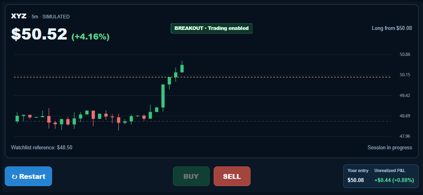
Watch a simulated stock chart unfold candle by candle. Decide when to buy, wait, or stay out across eight market scenarios.
8 interactive scenarios • No real money • Personalized feedback
Dagger Setup Score
How strong is your AAPL setup?
Should I Take This Trade?
A volatile selloff still needs a good decision.
Check the setup, risk, timing and your own decision-making before acting.
Check This Trade →Sources & notes
- Apple Newsroom: fiscal Q4 2026 earnings release, November 2, 2026 (company financial figures).
- MT Newswires: November 3, 2026, earnings versus FactSet consensus and intraday market reaction (provided Thinkorswim feed).
- Dow Jones Market Talk: November 3, 2026, Oppenheimer commentary on memory costs, Services and AI expenses (provided Thinkorswim feed).
- Benzinga: November 3, 2026, memory costs, December-quarter margin guidance and memory supply constraints.
- Benzinga: November 3, 2026, possible paid access to expanded Siri AI capacity and Services results.
- Benzinga / MT Newswires: November 3, 2026, analyst target changes (provided Thinkorswim feed).
- Technical levels are based on Dagger Trading's chart analysis as of November 4, 2026. These levels are reference points and may change as price action develops.
Try WWYD
The chart is only half the trade.
Would you chase a rebound after a sharp selloff, wait for confirmation or respect your risk limit? Put your decision-making to the test.
Dagger Trading Merch
Trade smart. Rep the mission. ☕
Check out the latest Dagger Trading mugs and designs.
Check Out Dagger Merch →