New Spotlight • October 19, 2026
CoreWeave slides toward its recent lows as investors weigh AI demand against rising financing costs
What matters most
- Debt and financing pressure: CoreWeave sold off sharply as credit investors demanded higher yields and questioned the cost of its rapid AI infrastructure expansion.
- Demand has not disappeared: The company has more than $129 billion in contracted backlog, but turning that demand into cash requires substantial upfront investment.
- Wall Street is divided: Bernstein remains cautious, while JPMorgan and Bank of America defend the contract economics. Goldman Sachs upgraded CRWV to Buy on October 19 with a $106 target.
- Near-term price test: The $59.25–$59.90 area is the immediate decision zone. A sustained break below it would bring $58.13–$58.90 into focus.
What happened?
CoreWeave rents specialized Nvidia-powered computing capacity to AI developers. The company signs long-term customer agreements but must spend heavily on GPUs, data centers and power infrastructure before collecting much of the contracted revenue.
During the week ending October 16, shares fell roughly a quarter as rising bond yields and concerns about AI infrastructure financing overwhelmed the strong demand narrative. Nvidia CEO Jensen Huang defended CoreWeave's financial strength, but investors remained focused on leverage and future borrowing costs.
On October 19, Goldman Sachs upgraded the stock to Buy. Shares nevertheless remained under pressure, reaching an intraday low of $59.25 before weakening again in extended-hours trading.
Latest News
Credit-market warning: CoreWeave's five-year credit default swaps reached 1,194.5 basis points on October 15, according to ICE Data Services figures cited by Bloomberg and Benzinga. Standard pricing models translated that spread into a five-year market-implied default probability above 60%. That is a model-derived credit-market signal, not a prediction that bankruptcy is inevitable.
Bond yields jumped: The company's 9.75% notes due October 2031 yielded approximately 15.08% on October 16, up from around 12% two months earlier. Elevated secondary-market yields do not mean CoreWeave pays that rate on all its existing debt.
Goldman turns bullish: Analyst Gabriela Borges upgraded CoreWeave from Neutral to Buy on October 19 and set a $106 target. The upgrade contrasts with credit-market worries and highlights the disagreement over the company's longer-term prospects.
Management pushes back: CEO Mike Intrator reportedly emphasized that contracted customer backlog exceeds debt obligations. The backlog supports future revenue visibility, but it is not equivalent to cash on hand or guaranteed profit.
Company Analysis: Strong Demand, Expensive Growth
CoreWeave's contracted backlog exceeds $129 billion, according to Bank of America commentary. Customers include major AI developers and technology companies. Long-term take-or-pay agreements provide more visibility than speculative capacity construction, but they do not remove execution, financing or customer-credit risks.
In the second quarter, CoreWeave generated about $679 million in operating cash flow while spending roughly $6.4 billion on equipment. Net interest expense more than doubled to approximately $640 million. The difference illustrates how much cash must be invested before newly built capacity can generate its full revenue stream.
JPMorgan estimates that typical five-year contracts could earn project-level returns in the mid-teens against an estimated 9%–11% cost of capital. It also estimates that adding a gigawatt of capacity can require more than $35 billion in upfront spending. These are analyst assumptions, and rising financing costs could narrow the return spread.
The central question is whether CoreWeave can finance its expansion at attractive rates long enough for its contracted capacity to produce durable cash flow. Strong AI demand and significant financial risk can exist at the same time.
Wall Street Reaction
Bernstein: Maintains an Underperform view, warning that leverage, lease obligations and expensive unsecured financing could undermine future returns.
JPMorgan: Analyst Samik Chatterjee maintained Overweight on October 16, emphasizing contracted demand and potentially attractive project economics. Its illustrative model suggests a more sustainable balance between cash earnings and expansion spending around 2030.
Bank of America: Maintains a constructive view, highlighting more than $129 billion in contracted backlog, customer commitments and support from major counterparties.
Goldman Sachs: Upgraded CRWV to Buy on October 19 with a $106 target, seeing potential upside despite near-term financing fears.
Barclays' broader-market perspective: Research chairman Ajay Rajadhyaksha argued that CoreWeave's problems should not automatically be extrapolated to the entire AI sector. His analysis estimates that even a complete halt in CoreWeave spending would remove no more than about 5% of total AI capital investment. That does not eliminate the company's individual financial risks.
Key Levels I'm Watching
October 19 technical roadmap. The $59.25–$59.90 area is the immediate decision zone. The $67.38–$69.04 resistance zone reflects the current week’s pivot and prior price structure; review it as new price action develops.
Upside / Resistance
The recovery levels to monitor if buyers regain control.
Downside / Support
The support areas to monitor if selling pressure continues.
The Roadmap
Upside: Buyers first need to reclaim the $59.25–$59.90 decision zone and then work through $62.38–$63.33 and $63.80. Above those areas, $65.58–$66.40, the $67.38–$69.04 zone, $71.44–$72.29, $73.67 and $76.07–$78.27 form successive resistance references.
Downside: A decisive break beneath the $59.25–$59.90 decision zone brings $58.13–$58.90 into focus. Beyond that, $55.89–$56.47, $53.40–$54.12 and the major $51.02–$51.28 support cluster are the next deeper areas. The $51.02–$51.28 zone deserves particular attention for a potential reaction, but a bounce would still need confirmation. Only if that zone fails do $48.35 and then $42.96–$43.55 become the next downside references. None is guaranteed to hold. A sustained break below $42.96–$43.55 would prompt a new Spotlight update with revised downside levels.
Trend context: Momentum remains weak, with price below key moving averages. Oversold short-term readings may lead to a reaction but do not, by themselves, establish a bottom. The $67.38 weekly pivot reference is specific to the week of October 19 and should be reviewed in future updates.
What matters next?
The first question is whether CRWV can defend and reclaim the $59.25–$59.90 decision zone. A recovery through $62.38–$63.33 and $63.80 would provide stronger evidence that buyers are regaining control, although the broader trend would remain damaged.
If the decision zone fails below $59.25, the next support test is $58.13–$58.90. Watch how price behaves around the zone rather than assuming a level will automatically produce a reversal. Bond yields, financing announcements and the economics of new customer contracts remain important fundamental catalysts.
Dagger Trading Take
Strong AI demand does not erase the cost of financing it.
CoreWeave has substantial contracted demand, but delivering that computing capacity requires enormous investment. Bulls believe long-term contracts can earn attractive returns; bears worry borrowing costs and leverage could overwhelm those economics. Both arguments deserve attention. For traders, the chart is a separate reality: price remains weak, and support has yet to prove itself. Watch the reaction around the $59.25–$59.90 decision zone before assuming a bottom is in place.
Momentum is key. Stay sharp.
Think You Can Control Your FOMO?
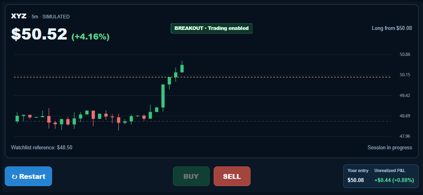
Watch a simulated stock chart unfold candle by candle. Decide when to buy, wait, or stay out across eight market scenarios.
8 interactive scenarios • No real money • Personalized feedback
Dagger Setup Score
How strong is your CRWV setup?
Should I Take This Trade?
A volatile selloff still needs a good decision.
Check the setup, risk, timing and your own decision-making before acting.
Check This Trade →Sources & notes
- Benzinga, October 16, 2026: JPMorgan commentary on CoreWeave contracts, project returns and expansion economics.
- Benzinga / Bloomberg / ICE Data Services, October 16, 2026: CoreWeave credit default swaps and October 2031 bond pricing.
- MT Newswires, October 16, 2026: Bernstein, JPMorgan and Bank of America perspectives on financing costs and demand.
- Benzinga / Reuters, October 19, 2026: distressed-credit concerns, management response and sector context.
- Barron's, October 19, 2026: Barclays' analysis of CoreWeave and broader AI capital spending.
- Benzinga, October 19, 2026: Goldman Sachs upgrade to Buy and $106 price target.
- Technical levels are based on Dagger Trading's Thinkorswim and TradingView chart analysis.
Try WWYD
The chart is only half the trade.
Would you chase a rebound after a sharp selloff, wait for confirmation or respect your risk limit? Put your decision-making to the test.
Dagger Trading Merch
Trade smart. Rep the mission. ☕
Check out the latest Dagger Trading mugs and designs.
Check Out Dagger Merch →