Latest Update • November 25, 2026
Nvidia rebounds after Jensen Huang returns, but investigations and resistance remain
What matters most
- Relief rally meets resistance: NVDA surged more than 31% Monday before falling Tuesday, after testing resistance identified in our previous update.
- Huang returns as CEO: Huang is back as CEO, but internal and government investigations continue.
- Analysts remain bullish despite uncertainty: Several analysts see substantial upside potential, despite concerns about the board’s oversight and chip export restrictions.
- Important support reclaimed: $150.33–$150.41 remains the immediate decision zone, with major resistance overhead.
What Happened
NVDA fell 14.01% on Friday, November 20, closing at $125.53 after reaching $124.50. On Monday, shares surged 31.48% to $165.05 following reports of Jensen Huang’s reinstatement as CEO. The rally reached $171.50, inside the $170.24–$172.35 resistance cluster identified in our November 19 update.
Tuesday brought a reversal, with shares closing at $155.38, down 5.86%. NVDA remained under pressure during overnight trading on November 25, consolidating above the important $150.33–$150.41 support area. The rebound has been substantial, but buyers have yet to establish a sustained recovery.
Latest News
Huang returns as CEO: Nvidia’s board unanimously voted to reinstate Huang on Monday. According to Benzinga’s November 24 reporting, President Donald Trump acknowledged encouraging the board to bring him back and expressed confidence that his return did not pose a national security risk. Nvidia also restored Huang to its board, while Colette Kress continues as CFO. In its November 23 announcement, the company confirmed that its independent investigation would continue, alongside a new export oversight committee and a search for a chief compliance officer. Trump also called for the internal export compliance review to continue.
Congressional hearings: Benzinga reported on November 20 that a public Senate Banking Committee hearing involving Huang was confirmed, although a date had not been finalized at the time. Subsequent Reuters reporting on November 23 identified December 3 for the public Senate hearing and December 1–2 for House committee interviews involving Huang and Nvidia’s general counsel.
Regulatory investigations: Reuters reported on November 20 that SEC enforcement staff were examining possible accounting issues. The exact focus of that inquiry remains unclear. California’s investigation also continues despite Huang’s return. These investigations do not establish wrongdoing.
Chip export concerns: On November 25, Benzinga reported that Singapore Prime Minister Lawrence Wong said his government needed additional information from U.S. authorities to trace chips purchased by Megaspeed and routed to other countries. The U.S. Commerce Department moved to blacklist Megaspeed entities in Singapore, Malaysia and Thailand on Monday, citing diversion risks. Singapore is seeking to verify documentation and end users. Wong said Singapore does not enforce American export restrictions itself but does not want companies using the country to evade them. Investigations remain ongoing.
Company Analysis: Leadership Returns, Business Risks Remain
Huang’s return could help restore confidence among customers, suppliers and financing partners. Nvidia’s November 17 earnings showed strong demand, with quarterly revenue of $115.8 billion. But customers still need the money, power and facilities to build new data centers. Delays in those projects could slow future growth.
UBS highlighted roughly $390 billion in Nvidia supply commitments, which could make it harder for the company to scale back financial support for its customers and partners.
Wall Street Reaction
Dan Ives: Raised his target from $225 to $250, citing Huang’s return and strong AI demand, while acknowledging unresolved China export issues. He stopped short of a $300 target because of unresolved export questions and upcoming congressional hearings.
UBS: Maintained Buy and a $220 target. The firm believes Huang’s return could ease uncertainty around financing, supply chains and retaining employees, but warned that new export restrictions could affect the wider technology industry.
StoneX: Cody Acree upgraded Nvidia from Hold to Buy with a $270 target, according to Benzinga.
Wedbush: Matt Bryson reiterated Outperform with a $293 target.
Benzinga Pro data cited November 24 showed 28 of 34 analysts rated Nvidia Buy or Strong Buy and six rated it Hold, with an average target of $248.43.
Governance concerns: Investor Steve Eisman questioned the board’s reversal and political involvement, while Kyle Bass criticized the company’s governance. Their comments represent opinions, not findings of misconduct. Analyst targets are longer-term estimates, not chart targets or guarantees.
Key Risks to Watch
- Regulatory findings: Upcoming testimony and ongoing inquiries could introduce new information about export compliance and accounting.
- China sales: Further export restrictions could affect access to customers and future demand.
- Governance: Investors may seek evidence that independent oversight is effective following the board’s reversal.
- AI infrastructure: Financing, power and construction constraints may affect the pace of new projects.
Key Levels to Watch
Most of the levels from our previous update remain important. Recent price action has changed which areas are acting as support and resistance.
Upside / Resistance
Areas buyers would need to reclaim for a more convincing recovery.
Downside / Support
Potential reaction areas if selling pressure continues; none is guaranteed to hold.
Dagger Trading Take
Huang is back, but Nvidia still has work to do on the chart.
Monday’s rally was impressive, but it ran into the $170.24–$172.35 resistance area identified in our previous update. Tuesday’s pullback is a reminder that one strong session does not necessarily reverse a downtrend.
For buyers: Holding $150.33–$150.41 and reclaiming $153.12–$153.50 would be encouraging. The next important test is $157.10–$158.13. If buyers can hold above that area, attention shifts toward $163.86–$165.00 and eventually Monday’s high.
For sellers: A sustained break below $150.33–$150.41 would bring $146.50–$146.69 back into focus. If selling continues, the $141.97–$142.92 area and $140.76 become increasingly important.
The bigger picture: NVDA remains below its daily 50, 100 and 200 SMAs, near $204.95, $209.09 and $203.07 respectively. The weekly 200 SMA near $124.82 has held for now. A sustained break below $124.50 would weaken the recovery and bring deeper support levels into focus.
Huang’s return may have restored some confidence, but it has not resolved the investigations, export restrictions or financing concerns. Until buyers start reclaiming and holding important resistance levels, it is too early to call this a sustained recovery.
Sources & notes
Sources reviewed for the November 25 update:
- Benzinga Newswire, Nov. 20, 9:34 PM ET: Senate hearing and reported SEC inquiry (Thinkorswim).
- Benzinga Newswire, Nov. 25, 12:29 AM ET: Singapore and Megaspeed investigation (Thinkorswim).
- Benzinga Newswire, Nov. 24, 9:27 PM ET: Dan Ives and analyst targets (Thinkorswim).
- MT Newswires, Nov. 24, 12:34 PM ET: UBS rating and risks (Thinkorswim).
- Benzinga Newswire, Nov. 24, 6:05 PM ET: Steve Eisman, board reversal and governance (Thinkorswim).
- Benzinga: Huang returns as CEO (Nov. 23)
- Nvidia’s November 23 reinstatement announcement (SEC filing)
- Reuters, Nov. 23: Federal and state investigations and hearing dates
- Reuters, Nov. 23: California investigation continues
The price levels in this article come from Dagger Trading’s chart analysis on November 24–25, 2026. Regular session and overnight trading activity are identified separately. Market conditions and moving averages can change. This article is educational, not investment advice.
Previous Update • November 19, 2026
Nvidia falls for a sixth session despite strong earnings as legal and financing concerns grow
What matters most
Nvidia's earnings showed strong demand for its AI products, but shares continued falling as investors weighed leadership uncertainty, investigations and questions about financing the AI buildout.
- Strong earnings, weak stock: Nvidia reported approximately $115.8 billion in quarterly revenue, more than double a year earlier, yet shares closed Thursday at $145.98 after six consecutive declining sessions.
- Leadership and legal uncertainty: Colette Kress is serving as interim CEO following Jensen Huang's resignation. California's attorney general has issued an investigative subpoena, adding to the scrutiny surrounding the company.
- AI financing questions: Reporting raised concerns about the progress of a proposed $500 billion Wall Street financing initiative and how AI infrastructure customers will fund future chip purchases.
- China and export uncertainty: U.S. authorities reportedly approved licenses for Nvidia and AMD to ship AI chips to Chinese customers. The approvals offer a potential path for sales, but restrictions and uncertainty over future shipments remain important concerns.
What Happened
Nvidia closed Thursday, November 19, at $145.98, down 3.3%, extending its decline to six consecutive trading sessions. MarketWatch, citing Dow Jones Market Data, reported that the company lost approximately $669 billion in market value during those six sessions, with shares falling about 16% over that period.
Nvidia reported approximately $115.8 billion in quarterly revenue on November 17, more than double the figure from a year earlier. But the stock kept falling as investors weighed the leadership change, investigations, chip exports and how customers will pay for major AI projects.
On the chart, NVDA repeatedly tested the $153.12 area during the week before failing to reclaim it. The stock then broke below the $150.41 support level and closed Thursday at $145.98, leaving that former support as an important level for buyers to reclaim.
Latest News
California opens an investigation: The Wall Street Journal reported that California Attorney General Rob Bonta issued an investigative subpoena to Nvidia. The state is examining whether chips or confidential information were shared with China and whether investors were misled. The subpoena and allegations do not establish wrongdoing. The inquiry adds to scrutiny following Jensen Huang's resignation and the appointment of CFO Colette Kress as interim CEO.
China chip licenses: MT Newswires, citing Bloomberg, reported that U.S. authorities had approved licenses for Nvidia and AMD AI processor shipments to Chinese customers. The report cited approvals covering 272,000 chips for Tencent, Alibaba, Baidu and BYD by May, within a larger group of nearly 880,000 approved chips. Approvals do not necessarily mean those chips were delivered. Export policy remains an important uncertainty for Nvidia.
AI financing faces questions: A November 18 Wall Street Journal report said the much-publicized $500 billion Wall Street initiative intended to help customers finance AI chips had not yet deployed capital. Financing talks continue, but the report described disagreements over how much credit support Nvidia should provide. This matters because some newer AI cloud customers depend on outside funding to purchase expensive computing systems.
Business remains strong: Nvidia's November 17 earnings release reported approximately $115.8 billion in quarterly revenue, with continued strength in data center demand. Sales are growing, but investors still have questions about leadership and how customers will fund their AI projects.
Company Analysis: Strong Growth, New Challenges
Nvidia's underlying business continues to grow rapidly. Its November 17 earnings showed quarterly revenue of $115.8 billion, up 103% from a year earlier. Data center revenue reached $107.6 billion, reflecting continued demand for the computing systems used to develop and run AI.
The company has also begun shipping its new Vera Rubin platform to major cloud providers. That gives Nvidia another source of potential growth as customers expand their AI infrastructure.
However, strong sales do not eliminate the challenges ahead. Nvidia expects its gross profit margin to decline from 74.8% in the latest quarter to approximately 71%–72% next quarter. Questions also remain about how newer AI cloud companies will finance expensive data center projects.
Nvidia's business remains strong, but investors are watching whether the company can maintain its growth and profitability while navigating leadership changes, customer financing concerns and export restrictions.
Wall Street Reaction
Analysts are divided: MT Newswires reported that Phillip Securities raised its Nvidia price target from $285 to $300, while Daiwa Securities cut its target from $245 to $185. These are analysts' longer-term estimates, not chart levels or guarantees.
MarketWatch on the selloff: MarketWatch reported a six-session decline of roughly 16%. The article cited concerns about Nvidia's leadership, its China business and investors pulling back from AI stocks. Nvidia's sales are growing, but that has not stopped the share price from falling.
Key Risks to Watch
- Leadership uncertainty: Nvidia is operating under interim CEO Colette Kress while its board searches for a permanent replacement. The ongoing investigations could create additional uncertainty.
- AI financing: Questions remain about how newer AI cloud companies will finance expensive infrastructure projects, particularly if Nvidia limits the financial guarantees it provides.
- China and export restrictions: Newly reported chip export approvals could help Nvidia reach Chinese customers, but future sales remain dependent on government policy and licensing decisions.
- Slowing growth expectations: Despite strong earnings, investors are watching whether Nvidia can sustain its rapid growth as the AI infrastructure market expands.
Key Levels to Watch
These are the main price areas selected from the broader chart review. Each marks a possible reaction point, not a guaranteed reversal.
Upside / Resistance
Areas buyers would need to reclaim for a more convincing recovery.
Downside / Support
Potential reaction areas if selling pressure continues; none is guaranteed to hold.
Dagger Trading Take
Strong earnings have not stopped the selling. Buyers need to prove they can hold a recovery.
The immediate problem: Nvidia repeatedly tested $153.12 before losing that area, then broke below the important $150.41 support level and closed Thursday at $145.98. Buyers now need to reclaim those former support levels while broader selling pressure continues.
For buyers: Reclaiming and holding $150.33–$150.41 would be an early improvement, but it would not reverse the downtrend by itself. The next tests are $153.12–$153.50 and $157.10–$158.13, followed by $163.29–$165.00 if the recovery continues. Above that, watch $165.91–$167.94 and $170.24–$172.35. A sustained break above the higher cluster could bring $173.94 into focus.
For sellers: $146.50–$146.69 is the first nearby area buyers would need to reclaim. If the decline continues, $141.97–$142.92 and especially $140.76 are the next possible reaction areas. If those areas fail, the next meaningful cluster is $134.06–$136.80, followed by $127.72. The lower $119.88–$121.63 area remains a more distant possibility, not a prediction.
The bigger picture: Nvidia's revenue growth remains impressive, but investors are weighing investigations, leadership uncertainty, export policy and financing risks. NVDA could bounce after six straight losing sessions, but buyers still need to reclaim the levels the stock recently broke and hold them if price pulls back again.
Sources & notes
Sources reviewed for the November 19 update:
- Nvidia fiscal Q3 2027 earnings release (Nov. 17)
- MarketWatch / Dow Jones Newswires, Nov. 19: six-session decline and market commentary (Thinkorswim news feed)
- The Wall Street Journal / Dow Jones Newswires, Nov. 19: California investigative subpoena (Thinkorswim news feed)
- MT Newswires, Nov. 19: China export licenses, citing Bloomberg (Thinkorswim news feed)
- The Wall Street Journal / Dow Jones Newswires, Nov. 18: $500 billion AI financing initiative (Thinkorswim news feed)
- MT Newswires, Nov. 19: Phillip Securities and Daiwa Securities price target changes (Thinkorswim news feed)
- NVDA historical prices
The price levels in this article come from Dagger Trading's chart analysis on November 19, 2026. Prices reflect the November 19 regular trading session, not extended hours. Market conditions and moving averages can change. This article is educational, not investment advice.
Previous Update • November 13, 2026
Huang steps down as NVDA tests major support ahead of earnings
What Happened
Nvidia faced a major leadership change this week as Jensen Huang resigned as CEO and from the board. Longtime CFO Colette Kress was named interim CEO, leaving investors to assess what the transition could mean for the company ahead of its November 17 earnings report.
The stock continued its sharp decline Thursday, November 12, falling to $148.80. That brought NVDA directly into the $146.50–$150.41 support area identified in our original November 10 Spotlight. Buyers stepped in, helping shares recover to a Thursday close of $166.19.
However, the rebound struggled to hold. NVDA fell again Friday, reaching an intraday low of $158.39 before closing the regular session at $162.85. After-hours trading ended at 8 p.m. ET, with NVDA at $161.01.
NVDA bounced from the support area we identified on November 10, but Friday's pullback showed buyers still have work to do. With Nvidia preparing to report earnings under interim leadership, investors will be watching both the company's financial outlook and how it plans to move forward.
Latest News
Nvidia's board accepted Jensen Huang's resignation on November 11, effective immediately. The company publicly announced his departure the following day. Colette Kress will remain CFO while serving as interim CEO. The board has begun a search for a permanent replacement, considering both internal and external candidates. Harvey C. Jones was also appointed board chair.
The departure follows reports about Huang's personal relationships and allegations involving possible foreign espionage. Nvidia's board previously said it had no reason to believe company secrets or national security had been compromised. The company has not stated that those allegations were the reason for his resignation.
Nvidia says it expects operations, customer commitments and its product roadmap to continue without interruption. Kress will lead Nvidia while the board searches for a permanent CEO. The November 17 earnings report will give investors a closer look at the company's business outlook.
Wall Street Reaction
Baird turns cautious: Analyst Tristan Gerra downgraded Nvidia to Neutral and lowered his price target to $200, citing leadership uncertainty and concerns about future AI spending and data center demand.
Mizuho lowers its target: Analyst Vijay Rakesh reduced his price target to $250 while maintaining a more positive outlook on Nvidia's underlying business.
Truist downgrades Nvidia: The firm lowered its rating from Buy to Hold and set a $174 price target amid concerns about Nvidia’s leadership transition.
Craig-Hallum moves to Hold: The firm downgraded Nvidia from Buy to Hold and set a $180 price target following Huang’s departure.
More analysts turn cautious: HSBC downgraded NVDA to Hold with a $170 price target. KeyBanc also downgraded the stock to Sector Weight. Bernstein lowered its rating to Market Perform with a $200 target. Not every firm turned bearish: Barclays maintained its Buy rating while lowering its target to $210.
These targets reflect analysts' estimates, not assurances that NVDA will recover.
Key Levels to Watch
Upside / Resistance
Key areas to watch if buyers regain control.
Downside / Support
Key areas to watch if the stock continues to fall.
Dagger Trading Take
NVDA bounced from support, but the recovery still faces resistance.
The support reaction: NVDA reached the support area identified in the original November 10 analysis, but Friday's pullback shows that the bounce alone does not confirm the selloff is over.
For buyers: The first recovery test is $163.29–$165.89. Holding above that area would shift attention to $170.24–$172.12, followed by $173.29–$173.94. A stronger recovery could eventually bring $185.94–$188.79 into focus.
For sellers: Losing Friday's $158.39 low would put $155.06 in focus. A deeper decline could retest $148.80–$150.41, part of the broader support area extending to $146.50. Below that, $142.76 becomes the next reference.
The bigger picture: Nvidia reports earnings on November 17. The reaction to the results and the leadership transition could quickly change the outlook. NVDA still needs to clear resistance before the recovery looks stronger.
Sources & notes
Reporting and company statements referenced in this update:
- Nvidia CEO transition announcement (Nov. 12)
- Nvidia SEC filing
- NVDA historical prices
- Analyst rating records (Nov. 11–13)
- Reuters: Leadership transition
Technical levels are based on Dagger Trading's chart analysis as of November 13, 2026.
New Spotlight • November 10, 2026
Nvidia faces a leadership test as investors look ahead to earnings
What matters most
Nvidia's shares fell sharply Tuesday as an investigation involving CEO Jensen Huang added uncertainty to a company already facing intense scrutiny over advanced AI chip exports. Investors are also watching how Nvidia handles the investigation, what it means for its leadership, and whether demand for its AI chips remains strong.
- The selloff: NVDA closed Tuesday at $168.89, down 5.47%, after trading as low as $165.89. These are regular-session figures, not after-hours prices.
- The board review: Independent Nvidia directors are investigating reports that Huang was targeted by a foreign intelligence effort. The board says it currently has no reason to believe company secrets or national security were compromised.
- Business exposure: Reporting has raised questions about chip sales linked to Megaspeed and possible export-control violations. The allegations have not been established as findings of wrongdoing by Nvidia or Huang.
- What's next: Nvidia reports fiscal third-quarter results on November 17. Earnings could provide an important look at AI demand, but may not resolve the investigation.
What happened?
NVDA extended its decline on Tuesday, November 10, closing at $168.89, down 5.47%, after falling as low as $165.89 during the session.
The selling came amid reports concerning Nvidia founder and CEO Jensen Huang and his relationship with Alice Huang, a former executive at Nvidia customer Megaspeed International.
Jensen Huang acknowledged an extramarital relationship in a message to employees and said he would cooperate with an investigation by Nvidia's independent directors. U.S. authorities have reportedly examined whether Alice Huang had ties to Chinese intelligence, raising concerns about whether Jensen Huang may have been targeted by a foreign intelligence operation.
Nvidia's board is investigating the matter, although the company has said it currently has no reason to believe confidential information or national security was compromised. The allegations remain under investigation, and no wrongdoing by Nvidia or Jensen Huang has been established.
For investors, the concern extends beyond the investigation itself. Jensen Huang has played a central role in Nvidia's growth, strategy, and customer relationships. Any uncertainty surrounding his leadership adds another challenge for the company as it faces increased scrutiny of AI chip exports and prepares to report earnings on November 17.
Latest News
Independent board investigation: In a November 8 statement, Nvidia said independent directors had begun an inquiry with outside counsel. On November 10, reports identified Wachtell, Lipton, Rosen & Katz and former acting U.S. Attorney Joon H. Kim as leading the outside legal review. The board expressed confidence in Huang and said it had no reason to believe national security or company secrets had been compromised.
Megaspeed and chip shipment allegations: Reports have linked Megaspeed, a Singapore-based Nvidia customer, to scrutiny over whether restricted AI chips reached China. Tuesday's reporting described allegations involving approximately $7.5 billion in chip shipments. That figure is a reported allegation, not a verified finding of illegal sales. Megaspeed has denied illicit chip transfers and said its investigations found no evidence of illegal activity.
Government and legal scrutiny: U.S. authorities and lawmakers have sought more information about the reported relationship and Nvidia's security controls. A shareholder lawsuit filed this week also alleges investors were misled about related risks. A lawsuit is a claim brought by plaintiffs, not a court determination that the allegations are true.
Huang remains in charge: Nvidia has said Huang intends to continue leading the company while cooperating with the independent review. The distinction matters: an investigation is underway, but no announced change in CEO has occurred.
Earnings are approaching: Nvidia has scheduled its fiscal third-quarter 2027 results for Tuesday, November 17, with its conference call at 5 p.m. ET. The company is expected to address operating performance and its outlook; investors may also listen for any updates on governance or export-related exposure.
Company Analysis: Nvidia’s Business and the Risks Ahead
Nvidia's business is not suddenly the same thing as its CEO controversy. In its most recently reported quarter, the company generated $96.2 billion in revenue, including $89.0 billion from Data Center. Those figures illustrate the scale of demand for its AI computing systems. Nvidia's previous outlook called for approximately $108 billion in fiscal third-quarter revenue, though actual results will not be known until the November 17 report.
Nvidia's business remains strong, but investors now have another issue to consider. If customers, regulators, or partners become concerned about how the company handles sensitive technology, Nvidia could face closer scrutiny and more difficulty selling chips overseas. Possible new restrictions on advanced chips sold to China are a separate risk. Those proposals are not the same as rules already in effect.
There are also questions about Nvidia's leadership. Huang helped turn Nvidia from a graphics chip company into a major supplier of AI computing systems. He remains closely involved in its strategy and customer relationships. Investors will be watching how the board handles the investigation and whether the company has a clear plan if its leadership ever changes.
For traders, the important distinction is between business performance and confidence in management. Strong earnings could support the stock, but they would not automatically settle the questions surrounding the investigation. Likewise, a falling share price does not establish that the allegations are true.
Wall Street Reaction
Citi trims its target: According to Barron's reporting on November 10, Citi analyst Atif Malik lowered his Nvidia price target to $285 from $315, citing pressure on chip valuations and uncertainty around leadership stability. A target is an analyst's longer-term estimate, not a prediction of where NVDA will trade tomorrow.
Some investors are buying the decline: Barron's reported that Cathie Wood's ARK Invest purchased 90,443 Nvidia shares on Monday, worth roughly $16 million at that day's closing price. The purchase shows that some investors continue to see long-term opportunity, but it does not establish that the selloff has ended.
Questions about Nvidia’s leadership: Analysts and commentators have questioned how smoothly Nvidia could operate if Huang's role changed. That is a governance issue worth monitoring, not evidence that a departure is planned.
Expectations remain demanding: Nvidia's valuation is tied to continued AI spending, strong margins, and the ability to supply customers at scale. The November 17 report will give investors a more concrete basis for judging whether the business outlook still supports those expectations.
Key Risks to Watch
- Investigation findings: New verified information could either ease concerns or raise more serious questions about company oversight and security.
- Export controls: Tighter restrictions or enforcement actions could affect some international chip sales and customer relationships.
- Leadership dependence: Uncertainty about succession planning could weigh on confidence even if the current CEO stays in place.
- Earnings volatility: Results on November 17 may trigger a substantial move in either direction, especially with expectations already high.
- Weak price action: A short-term bounce can occur during a larger decline. Buyers still need to reclaim and hold important levels.
Key Levels I'm Watching
These six areas are the main reference points from the broader chart. They are places to watch for a reaction, not promises that price will reverse.
Upside / Resistance
Key areas to watch if buyers regain control.
Downside / Support
Key areas to watch if the stock continues to fall.
Dagger Trading Take
A bounce is possible. Confirmation still matters.
NVDA's sharp decline has brought price close to the $164.27–$165.00 support area. Buyers showed some interest after Tuesday's low, but the broader daily chart remains under pressure. A rebound after heavy selling would not, on its own, confirm that the downtrend has ended.
For buyers: The first short-term checkpoint is $170.24, which NVDA moved back above during extended trading on November 10. Whether buyers can hold above it when regular trading resumes remains to be seen. If buyers can hold above $170.24, the next area to watch is $173.29–$173.94, the first major resistance zone. They still need to show they can hold the recovery.
For sellers: If the recovery fails and price slips back toward Tuesday's low, $164.27–$165.00 is the main support area to watch. A sustained break would shift attention toward $155.06, followed by the deeper $146.50–$150.41 zone.
The bigger picture: Next week's earnings could refocus attention on Nvidia's operating performance, but the independent investigation and possible export restrictions remain separate sources of uncertainty. Rather than predict the outcome, watch how price responds at these levels and whether new facts change the story.
Think You Can Control Your FOMO?
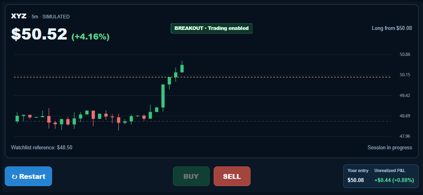
Watch a simulated stock chart unfold candle by candle. Decide when to buy, wait, or stay out across eight market scenarios.
8 interactive scenarios • No real money • Personalized feedback
Dagger Setup Score
How strong is your NVDA setup?
Should I Take This Trade?
A volatile selloff still needs a good decision.
Check the setup, risk, timing and your own decision-making before acting.
Check This Trade →Sources & notes
Reporting and company statements referenced in this article:
- NVIDIA Board of Directors, November 8 statement
- Reuters, November 10: Nvidia scrutiny and chip shipment allegations
- Reuters, November 10: Board oversight and investigation
- Associated Press: CEO investigation and shareholder concerns
- Citi and Wells Fargo target changes ahead of earnings
- Yahoo Finance: November 10 closing price and analyst ratings
Technical levels are based on Dagger Trading's chart analysis as of November 10, 2026.
Try WWYD
The chart is only half the trade.
Would you chase a rebound after a sharp selloff, wait for confirmation or respect your risk limit? Put your decision-making to the test.
Dagger Trading Merch
Trade smart. Rep the mission. ☕
Check out the latest Dagger Trading mugs and designs.
Check Out Dagger Merch →