Trading Psychology
Revenge Trading: Stop Chasing Your Losses
The next trade owes you nothing.
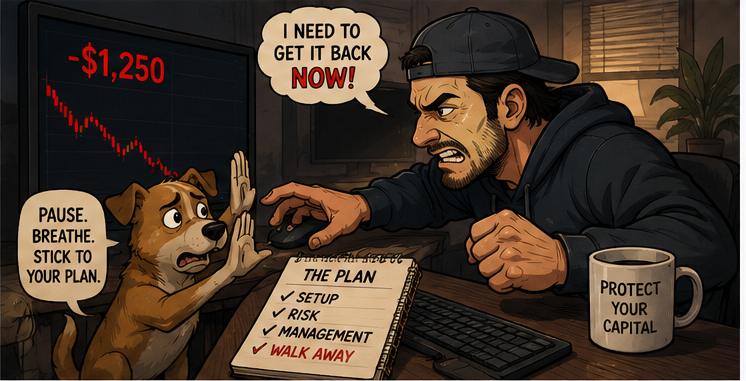
1. How the Pattern Develops
You take a valid setup.
The trade fails and money is gone.
The loss feels personal.
Recovery becomes the new goal.
You force another entry.
More risk creates more emotion and more mistakes.
2. Process vs. Emotion
| Disciplined Process | Emotional Process | |
|---|---|---|
| Next trade | ✓ Independent decision | ✕ Recovery attempt |
| Position size | ✓ Based on risk plan | ✕ Increased to make it back |
| Confirmation | ✓ Still required | ✕ Ignored because of urgency |
| Stop | ✓ Respected | ✕ Moved or removed |
| Mindset | ✓ Can accept another loss | ✕ Needs the next trade to win |
| Time horizon | ✓ Recovery has no deadline | ✕ Must get even today |
3. Quick Reset
- Pause: Is this trade actually in the plan?
- Risk: Is size defined before entry?
- Evidence: What confirms the setup?
- Invalidation: Where am I wrong?
- Choice: Can I comfortably skip this trade?
4. Outcome ≠ Decision Quality
Stopping after a loss can be active risk management, not weakness.
Getting the money back can reward the exact behavior that eventually causes a larger loss.
5. Warning Signs
- Increasing size immediately after a loss
- Re-entering the same stock repeatedly
- Entering before confirmation
- Thinking about getting back to green
- Moving or ignoring a stop
- Feeling anger or urgency at the order button
6. Key Takeaway
Your edge needs rules around it. The goal is not perfect execution—it is noticing when you drift and returning to the process.
7. Go Deeper (optional reading)
The deeper lesson
A realized loss can create urgency because another trade makes recovery feel possible. But the market has no relationship with your previous result. A useful reset question is: “Would I take this exact trade if I were flat on the day?” If the answer is no, the trade may be about emotional recovery rather than opportunity.
A simple practice
Before the next order, write down the setup, confirmation, invalidation and risk. After the trade, review whether you followed them. That keeps the review focused on behavior you can actually control.
Educational content only. This lesson is designed to improve trading process and risk awareness; it does not predict outcomes or provide personalized financial advice.
Run Dagger Check before the next trade. It can help you catch revenge-trading pressure before it drives the decision.
Open Dagger Check →