Trading Psychology
Stoicism & Trading
Control the trade, not the market.
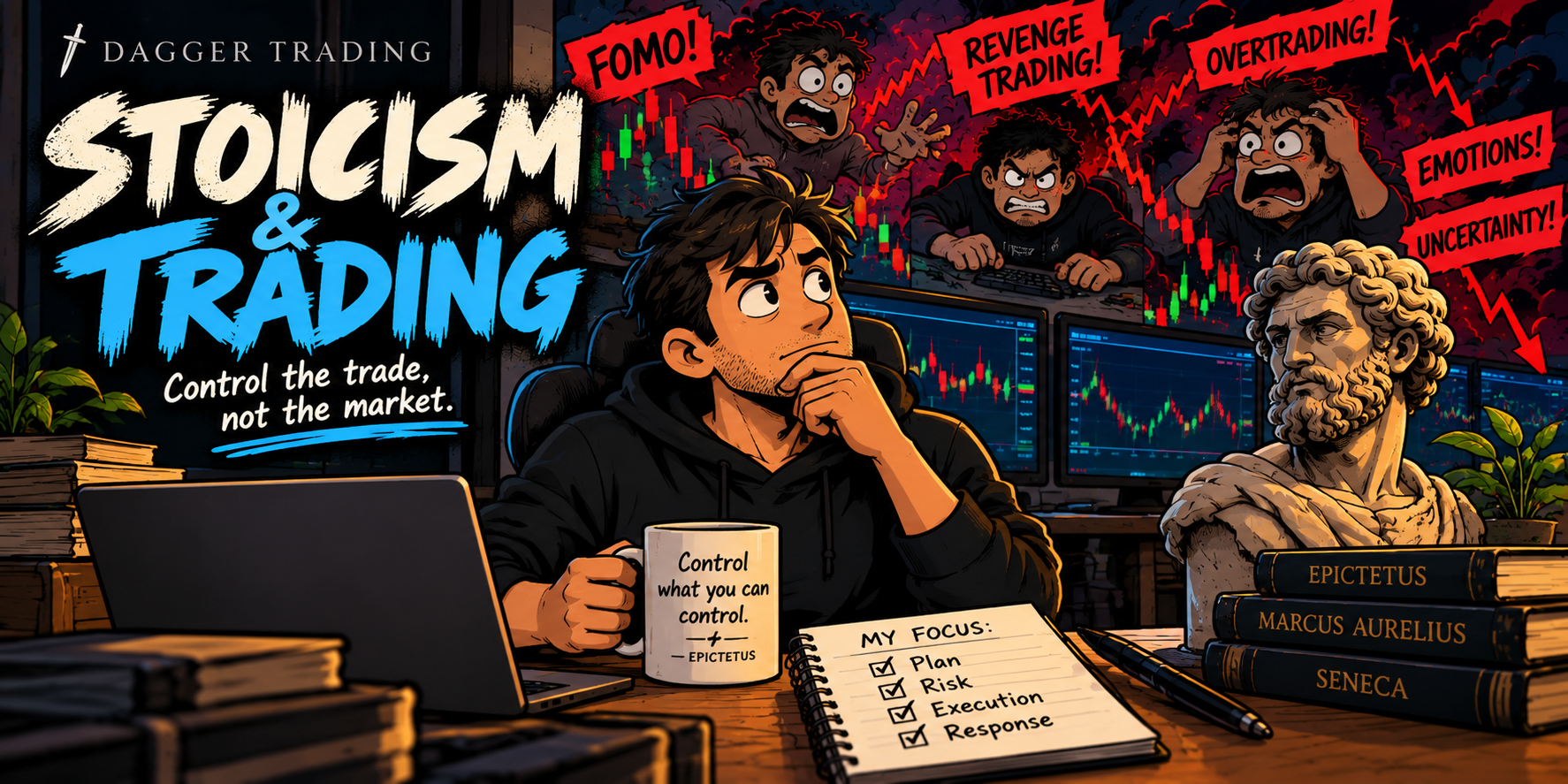
That uncertainty is part of trading. Stoic thinking helps separate what the market controls from what you control.
1. Control the Trade, Not the Market
One of the central ideas in Stoic philosophy is simple: put your energy into what is within your control and learn to accept what is not.
Trading makes that distinction brutally clear. You can study the chart, wait for confirmation and manage risk. None of that gives you control over what price does next.
Your real control is over your own decisions: whether you enter, how much you risk, whether you chase, whether you respect your exit and whether emotion gets to place the next trade.
2. The Two Sides of Trading
Your Setup
You control which opportunities meet your standards.
Your Risk
You control position size, planned loss and when you exit.
The Market
You do not control the next candle, breakout or reversal.
Your Response
You control what you do after the market surprises you.
3. A Good Decision Can Lose
A disciplined trade can lose. A reckless trade can make money.
If you judge every decision only by immediate P&L, a lucky bad trade can teach you the wrong lesson while a well-executed loss can make you abandon a good process.
4. The Market Owes You Nothing
You researched the stock. You waited. Your level looked perfect. The trade still failed.
The market does not know how much work you did, how badly you need a green day or how many losses came before this one.
5. Rehearse the Loss
Before entering, consider the outcome you do not want.
- What if this immediately goes against me?
- Where will I exit?
- How much will I lose?
- Can I accept that loss without needing to win it back?
6. The Past Trade Is Gone
You cannot change the trade that stopped you out. You cannot recover the entry you missed. You cannot go back and hold the winner you sold too early.
FOMO and revenge trading both pull your attention toward something that has already happened.
7. Feel It. Don't Obey It.
Stoicism is not about pretending you have no emotions. Frustration, fear, excitement and regret will still show up.
The important distinction is between feeling an emotion and allowing that emotion to make the next financial decision.
8. Turn Stoic Thinking Into Rules
- If I am trying to win back a loss, then I step away.
- If I missed the move, then I judge the setup at its current price.
- If I cannot calmly accept the planned loss, then I reduce size or skip the trade.
- If the market gives me no setup, then I do not manufacture one.
9. Key Takeaway
You will never control what happens after you enter. You can control your risk, standards, patience and response.
10. Go Deeper (optional reading & practice)
The Stoic idea of control
The Stoic philosopher Epictetus opened the Enchiridion by separating things that are up to us from things that are not. The ancient examples were not about markets, but the distinction translates naturally to trading: your judgments and actions belong to you; external outcomes do not.
Premeditatio malorum: considering adversity beforehand
Stoic practice also included deliberately considering setbacks before they happened. For a trader, this does not mean expecting every trade to fail. It means entering with the losing scenario already considered: where you are wrong, what the loss will be and how you will respond.
When the unwanted outcome has already been mentally acknowledged, it can be easier to execute the plan instead of improvising under stress.
Stoicism is not emotional suppression
A useful trading interpretation is not “I must feel nothing.” Markets can trigger real frustration, fear and excitement. The practical goal is to notice those reactions without automatically turning them into actions.
The obstacle becomes information
Marcus Aurelius wrote about the mind's ability to turn an impediment to action into something useful for action. In trading, we can apply that idea by treating a failed setup, missed move or emotional mistake as information rather than something we need to immediately correct with another trade. Maybe your size was too large. Maybe missing a move makes you chase. Maybe consecutive losses change your standards.
Instead of only asking, “Why did this happen to me?” ask, “What is this showing me about how I trade?”
Stoic Trader Exercise: What Can You Control?
Imagine this: You get stopped out for a $100 loss. Five minutes later, the stock reverses and runs without you. Before revealing each answer, pause for a moment and decide what belongs in that category.
- Outside my control: The stock reversing after my stop.
- Inside my control: The position size I chose before entering.
- Inside my control: Whether I chase the stock after it reverses.
- Not always under immediate control: Feeling frustrated.
- Inside my control: Whether that frustration places another trade.
Build Your Stoic Reset
Think about something outside your control that regularly affects your trading. Then decide what response remains within your control.
Your entries stay in this browser. Nothing is submitted to Dagger Trading.
My Stoic Trader Reset
Focus on the response, not the outcome.
Control the trade, not the market.
The goal is not to become indifferent to outcomes. It is to stop letting outcomes control your next decision.
Further reading
- Epictetus, Enchiridion 1, for the opening distinction between what is and is not up to us. Read The Enchiridion on Amazon →
- Marcus Aurelius, Meditations 5.20, for the idea that the mind can turn an impediment to action into material for action. Read Meditations on Amazon →
- Seneca, Moral Letters to Lucilius 18, 76, 91 and 98, for practical reflections on anticipating adversity, preparing for reversals and responding steadily when events do not go as expected. Read Letters from a Stoic on Amazon →
Affiliate disclosure: As an Amazon Associate, Dagger Trading may earn from qualifying purchases.
Educational content only. Dagger Trading is applying ideas from Stoic philosophy to trading psychology; Stoicism does not remove market risk or guarantee better trading results. This is not psychological or financial advice.