Trading Psychology
Trading Discipline: Build Consistency One Trade at a Time
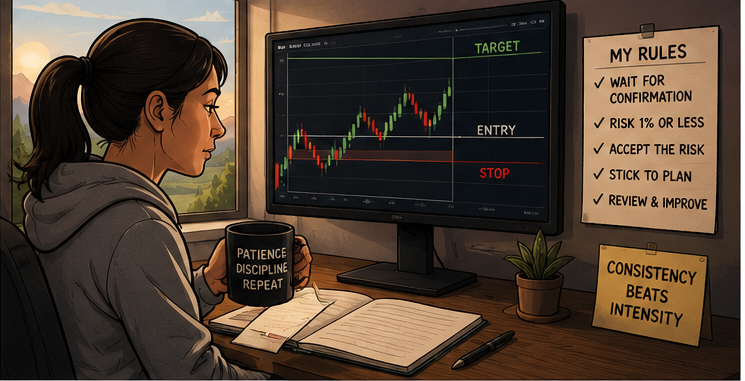
Consistency beats intensity.
1. How the Pattern Develops
Define the setup, risk and invalidation.
Let the market come to your level.
Require the evidence your setup needs.
Take the trade you planned.
Let the outcome be uncertain.
Grade the decision and repeat the process.
2. Process vs. Emotion
| Disciplined Process | Emotional Process | |
|---|---|---|
| Setup | ✓ Defined before action | ✕ Invented in the moment |
| Entry | ✓ Waits for confirmation | ✕ Anticipates from impatience |
| Risk | ✓ Known and consistent | ✕ Changes with emotion |
| Stop | ✓ Part of the plan | ✕ Negotiated after entry |
| Missed trade | ✓ Accepted | ✕ Chased |
| Success | ✓ Following process | ✕ Being right today |
3. Quick Reset
- Pause: Is this trade actually in the plan?
- Risk: Is size defined before entry?
- Evidence: What confirms the setup?
- Invalidation: Where am I wrong?
- Choice: Can I comfortably skip this trade?
4. Outcome ≠ Decision Quality
A disciplined loss is part of trading. You executed what you could control.
A profitable rule-break can be more dangerous than a clean loss because it rewards inconsistency.
5. Warning Signs
- Entering early because waiting feels difficult
- Moving stops without new evidence
- Changing size based on recent wins or losses
- Chasing a move you already missed
- Breaking rules because this trade feels different
- Judging discipline only by daily P&L
6. Key Takeaway
Your edge needs rules around it. The goal is not perfect execution—it is noticing when you drift and returning to the process.
7. Go Deeper (optional reading)
The deeper lesson
Discipline becomes easier when the rules are concrete. Define what qualifies as a setup, what confirms it, where the idea is invalid, how much you will risk and what makes you stop trading. Then review whether you followed those rules. Consistency is built by repeating controllable behaviors, not by demanding a particular result from the market.
A simple practice
Before the next order, write down the setup, confirmation, invalidation and risk. After the trade, review whether you followed them. That keeps the review focused on behavior you can actually control.
Educational content only. This lesson is designed to improve trading process and risk awareness; it does not predict outcomes or provide personalized financial advice.