Trading Psychology
Trading vs. Gambling: When Does Trading Cross the Line?
A winning trade can be a gambling decision. A losing trade can be a good trading decision.
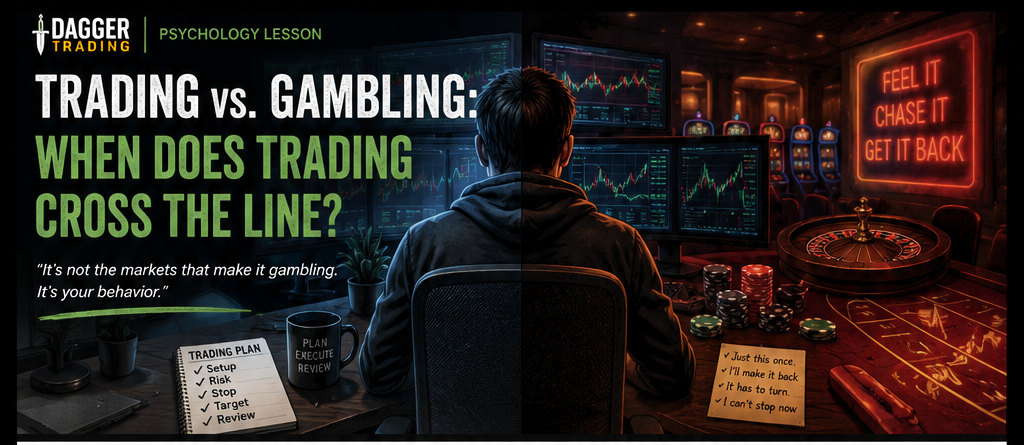
The difference isn't the chart or the market. It's the process, mindset, and behavior behind each decision.
1. The Slippery Slope: How Trading Can Cross the Line
You follow your plan and execute your setup.
The trade loses. It happens. You accept it.
Emotion kicks in. You want to be right. You want it back.
You increase size to “make it back faster.”
You take trades that don't meet your plan.
No plan. No edge. Just hope. You're gambling now.
2. Trading vs. Gambling: The Real Difference
| Trading | Gambling Behavior | |
|---|---|---|
| Setup | ✓ Defined setup | ✕ “I think it's going up” |
| Risk | ✓ Known before entry | ✕ Figured out afterward |
| Being wrong | ✓ Accepts it | ✕ Needs the trade to work |
| Size | ✓ Intentional | ✕ Based on excitement or desperation |
| Thinking | ✓ Probabilities | ✕ Predictions and certainty |
| Exit | ✓ Has an invalidation point | ✕ Holds and hopes |
| Participation | ✓ Can skip the trade | ✕ Feels compelled to trade |
| Review | ✓ Reviews execution | ✕ Only cares about P&L |
3. What the Research Found
- 8 excessive traders in France: researchers found a pattern that included early wins, chasing losses, and eventually losing control over money invested.
- 1,429 Spanish adults: a 2025 study identified a “gambling-traders” subgroup marked by more frequent trading, impulsivity, gambling-related biases, and higher problem-gambling scores.
- 467 Canadian day traders: among day traders, more gambling activities and stronger gambling fallacies were linked with moderate-risk/problem gambling.
- 795 U.S. gambler-investors: higher problem-gambling scores were associated with greater stock portfolio turnover even after controls for financial literacy and overconfidence.
4. Outcome ≠ Quality of Decision
You followed your plan. The trade lost. You controlled what you could control.
You had no plan. You got lucky. Luck is not a strategy.
5. Warning Signs You May Be Crossing the Line
- Increasing size after losses
- Taking setups you normally wouldn't take
- Needing to make the money back today
- Trading just to stay engaged or reduce boredom
- Moving stops or averaging down because you can't accept being wrong
- Judging every decision only by whether it made money
- Feeling anger, fear, or desperation while trading
- Knowing you should stop, but continuing anyway
6. Key Takeaway
Discipline is the line. Process is the anchor. Your goal isn't to be right. It's to make good decisions over and over again.
Not your emotions.”
7. Go Deeper (optional reading)
Trading is not automatically gambling
Markets involve uncertainty, and every trade can lose. That alone does not make trading gambling. A trading process can define the setup, risk, invalidation and position size before money is committed. The danger is when those controls disappear and the objective shifts from following an edge to satisfying an emotional need.
Why chasing losses matters
Chasing changes the purpose of the next trade. Instead of asking, “Is this a good setup?” the trader starts asking, “Can this get my money back?” That subtle change can lead to weaker setups, larger size and more impulsive decisions.
What the studies actually say
Research does not say every active trader is a gambler. It does show overlap between problem-gambling traits and certain trading behaviors, especially excessive frequency, chasing, impulsivity and loss of control. The French case series is particularly useful because its authors explicitly concluded that investing is not itself gambling, while noting that some people can use investments to gamble.
Research sources
- Grall-Bronnec et al. — Excessive trading and gambling disorder (8-trader case series)
- 2025 Public Health study — 1,429 adults and the “gambling-traders” subgroup
- Leslie, Shaw & McGrath — Day traders and gambling behaviors in Canada
- The stock market as a casino — 795 U.S. gambler-investors and trading frequency
Educational content only. This lesson discusses trading behavior and published research; it is not a clinical assessment or financial advice.