Trading Psychology
Why Traders Overtrade
More trades do not mean more edge.
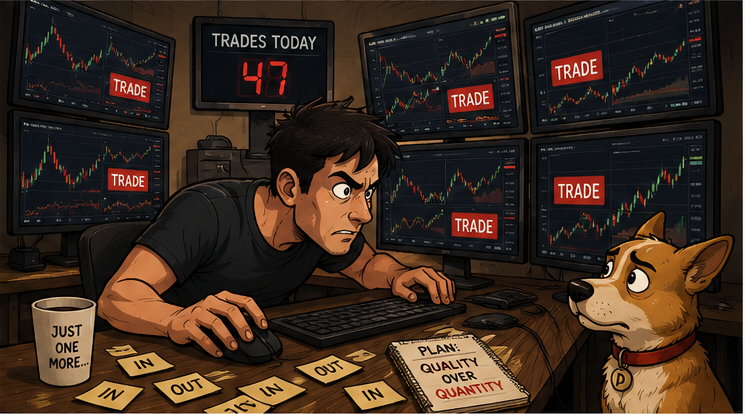
1. How the Pattern Develops
You take a trade that fits your plan.
Nothing clean appears next.
Being flat starts to feel uncomfortable.
You lower your standards just a little.
Activity replaces selectivity.
Fees, mistakes and emotion begin to stack.
2. Process vs. Emotion
| Disciplined Process | Emotional Process | |
|---|---|---|
| Goal | ✓ Best available setups | ✕ Stay busy |
| Frequency | ✓ As many as qualify | ✕ As many as possible |
| Waiting | ✓ Part of trading | ✕ Feels like wasted time |
| Setup quality | ✓ Standards stay fixed | ✕ Standards drift lower |
| After a loss | ✓ Reassesses | ✕ Immediately looks for another |
| Review | ✓ Measures quality | ✕ Counts action and P&L |
3. Quick Reset
- Pause: Is this trade actually in the plan?
- Risk: Is size defined before entry?
- Evidence: What confirms the setup?
- Invalidation: Where am I wrong?
- Choice: Can I comfortably skip this trade?
4. Outcome ≠ Decision Quality
Missing a move is cheaper than forcing a setup that was never yours.
A few wins can hide a deteriorating process and teach you to keep clicking.
5. Warning Signs
- Scanning for reasons to enter instead of reasons to wait
- Taking trades you would skip on a calm day
- Feeling uncomfortable when you are flat
- Repeatedly re-entering the same ticker
- Increasing trade count after a loss
- Confusing screen time with productive trading
6. Key Takeaway
Your edge needs rules around it. The goal is not perfect execution—it is noticing when you drift and returning to the process.
7. Go Deeper (optional reading)
The deeper lesson
Overtrading is not defined by a specific number of trades. The better question is whether each trade independently met your criteria. If the standards become looser as the session continues, or you trade mainly to relieve boredom, frustration or the need to stay engaged, activity has started replacing process.
A simple practice
Before the next order, write down the setup, confirmation, invalidation and risk. After the trade, review whether you followed them. That keeps the review focused on behavior you can actually control.
Educational content only. This lesson is designed to improve trading process and risk awareness; it does not predict outcomes or provide personalized financial advice.
Run Dagger Check. It can help you catch boredom, frustration or the urge to keep trading when stopping may be the better move.
Open Dagger Check →