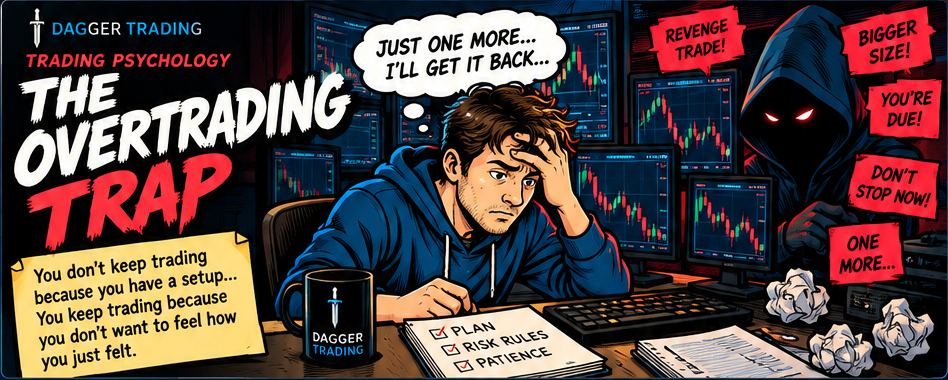
You know your strategy. You know your risk rules. You even recognize when you're emotionally compromised. So why do you keep clicking? The trap is not always about making money back. Sometimes the next trade is an attempt to escape how the last trade made you feel.
New here? Start with the lesson to understand the patterns, then test yourself with five trading scenarios.
1. The Scalper's Reflex
⚡
Scalping itself is not the problem. But reacting to every tick can make clicking feel automatic. A stock runs, you chase without a setup. It dips, you escape. It rebounds, you chase again.
Fast feedback can make waiting feel unbearable.
2. Trading for Relief
🧠
After a loss, entering another trade can temporarily replace frustration with hope. You may feel better before the trade earns a cent.
The emotional payoff can arrive before the financial result.
3. The Reinforcement Loop
🔄
If clicking briefly relieves frustration, the urge can grow stronger even when the trade loses money. Occasional lucky wins can reinforce the habit too.
Relief today can strengthen tomorrow's impulse.
4. The Stop-Out Spiral
📉
The warning point is different for every trader. Some struggle after two losses, others after four or five. One large loss or even a missed move can also trigger the urge to force trades.
Recognize your own warning signs before discipline slips.
Loss → frustration → another trade → temporary relief → more risk → another loss
5. The Chase and Regret Cycle
You fear being wrong, so you hesitate. Then the stock runs and FOMO takes over. You enter late, a normal retracement feels like another mistake, and you exit. The move may continue without you.
A late entry can turn normal price action into emotional pressure.
6. The Analyst vs. the Trader
It's possible to map a setup accurately yet struggle to trade it. Analysis happens at a distance. Execution adds exposure, uncertainty, and the memory of past losses.
A correct forecast is not proof that every possible entry was a good trade.
7. The Hidden Cost
Overtrading costs more than commissions and losses. It drains attention and leaves less focus for better setups. The trader who spent all day forcing scalps may be too exhausted to evaluate tomorrow's best opportunity.
Your mental energy is part of your trading capital.
8. Stop Before You Stop Caring
Every trader has a different emotional threshold. Notice when your decisions start changing, whether after two stop-outs, five, one unusually large loss, or a missed move. Set your own circuit breaker while calm, before you reach that point. Use appropriate size, firm risk limits, and practical platform barriers where available.
Your emotional limit is personal. Set your circuit breaker before you reach it.
9. Give the Setup Room
Define the entry, invalidation, and target before entering. Size the position so a normal retracement does not feel intolerable. An emotional exit can lead to another impulsive entry, turning one planned trade into several unplanned ones. An emotional exit and a valid stop are not the same thing.
Judge the decision by the plan, not by what price did afterward.
10. Test Yourself: The Overtrading Experiment
Five trading scenarios. Explore how frustration, missed opportunities, and even winning streaks can influence your decisions. Choose what you would do in each situation and see what your choices reveal about your trading habits. There is no score. It's an opportunity to recognize when emotions begin taking over.
✦
DAGGER TRADING · INTERACTIVE EXPERIMENT
The Overtrading Trap
Can you recognize when the next trade is driven by emotion rather than your plan?
5 scenariosNo scorePersonal reflection
This is a reflection tool, not a recommendation to keep trading until you hit that number. Financial risk limits always apply.
Scenario 1 of 5
You have reached your personal warning point. You feel yourself getting irritated. What now?
🗡️
11. KEY TAKEAWAY
You do not need another trade to repair how the last one made you feel. Your next breakthrough may be recognizing the urge and choosing not to click.
“The goal is not to trade more. The goal is to trade better.”
12. Go Deeper: Why Is It So Hard to Stop Trading?Explore the psychology behind emotional trading, reflect on your habits, and learn practical ways to reset.Click to explore →Click to collapse ↑
Why Another Trade Can Feel Like Relief
Negative reinforcement is often misunderstood. It does not mean punishment. It means a behavior becomes more likely because it removes or reduces something unpleasant. After a painful loss, clicking BUY may briefly remove the feeling of helplessness. That relief can teach the brain to click again the next time frustration arrives.
Winning works differently. An impulsive trade that pays off can reward the same behavior. Temporary relief and occasional wins can make a costly pattern difficult to break. This is one possible explanation for repeated overtrading, not a diagnosis of any individual trader.
1. Trading to Feel Better
After a loss, another trade can feel like a fresh start. Clicking Buy or Sell gives you something to focus on besides the frustration, even when the setup is weak. For a moment, the discomfort fades. But that relief can teach you to reach for another trade whenever a loss feels hard to accept. The next entry becomes less about the chart and more about changing how you feel.
Ask: Would I still take this trade if I felt calm?
2. The Setup You Saw but Did Not Trade
A trader identifies support and a possible move toward resistance. The setup begins to confirm, but after hours of rapid scalping, they are too drained to evaluate it calmly. By the next morning, price has moved toward their target.
That does not mean the trade was guaranteed. It could have failed, and holding overnight carried risk. The real issue is that exhaustion prevented a clear decision.
Ask: Did I miss the setup because it failed my plan, or because I was mentally exhausted?
3. When the Checklist Is Not Enough
A checklist can reveal that you're frustrated. But if you already know and do not care, you need a barrier stronger than a reminder. Set a maximum loss, a personal limit on consecutive stop-outs, or a session cutoff while calm. Consider simulated trading while rebuilding the habit.
Ask: What safeguard would still work when I do not feel like following my rules?
4. Knowing When to Stop Isn't Enough
You recognize the frustration. You know another trade would break your rules. But closing the platform means accepting the loss or missed move, so you keep looking for a reason to click.
That is the moment awareness needs to become action. A rule only protects you when you follow it, especially when stopping feels uncomfortable.
Ask: When I know I should stop, what keeps me looking for one more trade?
Reflection: What Is Driving the Next Click?
When you feel the urge to take another trade, are you responding to a setup or trying to change how you feel?
Think about your last unnecessary trade. What feeling did it promise to fix? What would have helped you walk away?
Personal Trading Reset
Use this short exercise to turn the five session reset into a plan you can actually follow. Your answers stay on this page and are not submitted anywhere.
Five Session Reset
Write one planned setup before the session, including entry, invalidation, and target.
Use simulated or very small positions while practicing the process.
Record each urge to chase, even if you do not place the trade.
Stop at your predetermined emotional or risk limit.
Grade the session by rule adherence, not profit or loss.
If you repeatedly feel unable to stop despite financial harm, consider speaking with a qualified mental health professional experienced in compulsive behaviors. Trading discipline tools can help, but they are not a substitute for support when control feels lost.