Strong AI earnings could not stop a broad market selloff.
Stocks fell throughout the week, and selling accelerated Friday. Nvidia delivered powerful revenue growth, but investors remained uneasy about the outlook for AI spending and the sharp decline in technology stocks. By Friday's close, the S&P 500 had entered correction territory. The problem was no longer confined to one stock.
The Market: A Week of Heavy Selling
The S&P 500 fell about 8.6% for the week, finishing Friday at 6,910.39. The Nasdaq Composite dropped about 10.0% to 22,617.73. The Dow lost about 8.0% to 48,147.33, while the Russell 2000 declined about 7.5% to 2,581.79. These are index closing values, not SPY or QQQ ETF prices.
Friday was especially severe. The S&P 500 lost 3.7% in a single session and finished more than 10% below its October 6 record, meeting the common definition of a market correction. The Nasdaq dropped 5.3% Friday. Selling across large technology stocks weighed heavily on the indexes, but losses also reached smaller companies and other sectors.
Nvidia's results were strong. Investor confidence was not.
Nvidia reported third-quarter fiscal 2027 revenue of approximately $115.8 billion, up 103% from a year earlier, and projected roughly $130 billion in revenue for the following quarter. Those were strong results, showing that demand for AI computing remained substantial even as technology stocks came under pressure.
Nvidia's results also give investors a broader look at demand across the AI industry. Its chips are used by data centers, cloud companies and other technology businesses, so its sales and outlook can help show whether spending on AI remains strong. The earnings offered some reassurance about demand, but they weren't enough to stop the broader selloff.
Investors were also questioning how much companies are spending on AI and whether that investment will pay off. Even a company with fast-growing sales can see its shares fall when investors become less willing to pay high prices for future growth.
For traders, the next question is whether buyers can hold a recovery in Nvidia and the wider technology sector. A bounce after a sharp decline would not be unusual. A sustained recovery would be more encouraging than a brief rebound that quickly fades. Strong earnings alone do not tell us when the selling is over.
AI Stocks Lead the Decline
Technology and chip stocks took some of the biggest hits. Nvidia lost roughly 22.9% over the week, according to market data reported after Friday's close. The selling spread beyond Nvidia as traders questioned how much companies would keep spending on AI and whether future earnings could meet expectations.
SPY and QQQ struggled to hold their rebounds. After several down days, a bounce would not be surprising. The bigger test is whether buyers can keep it going.
Anthropic's Public Debut Arrives During a Difficult Week
Anthropic's long-awaited market debut drew attention to AI valuations at a particularly unsettled moment. Its Thursday trading debut came as technology stocks were already under pressure. The debut gave traders another chance to see whether investors were still willing to pay high prices for AI companies. It did not, on its own, signal that the rest of the sector was recovering.
A company can have a promising future while its stock is already priced for years of strong growth. Even a closely watched IPO may draw attention without lifting the rest of the market.
Economic Data and the Fed: Why Rate Expectations Mattered
Investors also watched economic news for signs that interest rates might come down and give stocks some relief. The Federal Reserve's October meeting minutes were one part of that picture, alongside bond yields and expectations for future policy decisions.
Falling Treasury yields can sometimes help technology stocks, but that did not lead to a lasting rebound this week. Investors had other concerns, including how much growth companies could deliver and whether their share prices were too high.
Fed Minutes and Bond Yields
Minutes from the Federal Reserve's October 27–28 meeting, released November 18, showed that policymakers remained concerned about inflation and the path of interest rates. Meanwhile, the 10-year Treasury yield declined during the week as investors sought the relative safety of government bonds.
Even with yields falling, buyers did not return to technology stocks in a meaningful way. Lower borrowing costs can help, but they cannot erase every concern investors have about a company or the market.
Dagger Trading: Latest Stock Spotlights
This week's featured analysis includes our November 18 Palantir (PLTR) Spotlight and updated coverage of Nvidia (NVDA), originally published November 10. Both look at the selling pressure facing technology stocks and the price levels traders are watching.
New Spotlight • November 18 • PLTR
PLTR: Strong Growth, Selling Pressure and Key Levels
Palantir reported strong earnings on November 2, but that growth did not stop the selling in its shares. After the stock lost important support, the broader decline in technology stocks added to the pressure. Traders were watching whether buyers could regain those broken levels or whether the decline would continue.
Our November 18 PLTR Spotlight covers the earnings, the selling pressure and the key resistance and support areas on the chart. It looks at what buyers would need to reclaim for a stronger recovery and where the stock could find support if selling continues.
Updated Spotlight • Originally November 10 • NVDA
NVDA: Earnings Strength Meets New Pressure
Nvidia's earnings showed strong demand for AI computing, but that wasn't enough to stop the selling in its shares. Investors were also weighing how much companies are spending on AI and whether future growth can justify current valuations.
Our updated NVDA Spotlight covers the latest earnings reaction and the key price areas on the chart. It highlights what buyers would need to reclaim for a stronger recovery, where sellers could step in again, and which support levels deserve attention if the decline continues.
What the Week Taught Us
This week offered a reminder that a strong earnings report and a strong stock are not the same thing. Nvidia's growth numbers were impressive, but investors were still reluctant to buy amid the uncertainty. Traders who assumed that good news had to produce a rally were confronted with a very different reaction.
After repeated declines, the temptation is to buy simply because a stock looks cheaper than it did a few days earlier. But a lower price alone does not establish support. Waiting for price to stabilize and defining risk before entering can be more useful than trying to predict the exact bottom.
Can buyers stabilize after the selloff?
The November 23–27 trading week arrives with markets coming off one of their steepest weekly declines in years. Traders will be watching for signs that selling pressure is easing, especially in Nvidia, semiconductors and other large technology names.
Economic releases, additional corporate earnings and the Thanksgiving holiday schedule could influence trading conditions. U.S. stock markets will be closed Thursday for Thanksgiving, with regular stock trading ending at 1:00 p.m. ET on Friday. Trading conditions may differ from a normal week.
For SPY and QQQ, the first question is whether a bounce can hold. A single strong session would not erase the damage from this week's decline. We'll examine the upcoming calendar and the levels worth watching in the next Week Ahead.
Think You Can Control Your FOMO?
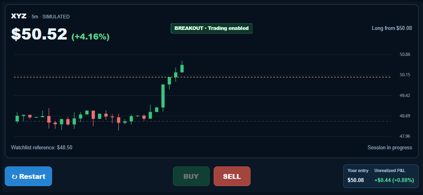
Watch a simulated stock chart unfold candle by candle. Decide when to buy, wait, or stay out across eight market scenarios.
8 interactive scenarios • No real money • Personalized feedback
🎮 Interactive Trading Challenge
Think You'd Make the Right Trade?
Make your choices through realistic trading scenarios involving FOMO, breakouts, stops, revenge trading and trade management... then see what you should consider before making the decision.
Dagger Trading Merch
Check out the latest Dagger Trading mugs. ☕
Trading humor, psychology, and Dagger designs... built for traders who know the battle isn't always with the chart.
Check Out the Mugs →Continue Exploring
More from Dagger Trading
Thanks for reading this Weekly Market Wrap. Explore more original content focused on trading psychology, market preparation, patience, and risk management.
Interactive Trading Challenge
Think You'd Make the Right Trade?
Make your choices through realistic trading scenarios and see where your discipline and decision-making lead.
Play What Would You Do?Original Content
Trading Comics
Humor and hard-earned market lessons covering FOMO, overtrading, momentum, patience, and risk.
View Trading ComicsFeatured Resource
Trading in the Zone
Mark Douglas's classic book on probabilities, discipline, emotional control, and developing a more consistent trading mindset.
Explore Recommended BooksLive Market Tools
Market Center
Check major index quotes, market news, earnings dates, and useful links for preparing your next trade.
Open Market CenterFollow Along
@DaggerTrading
Follow for new Stock Spotlights, market notes, trading psychology, charts, and original comics.
Follow on XDagger Trading Merch
Check Out the Latest Mugs
Trading humor, psychology, and Dagger designs... now available on mugs.
Check Out the Mugs →Sources
- Associated Press — November 20 index closes and weekly changes
- Nvidia — Official fiscal third-quarter 2027 results
- Nasdaq — Anthropic November 19 trading debut
- Anthropic — IPO closing announcement, November 20
- Federal Reserve — October meeting minutes, released November 18
- NYSE — 2026 holiday trading hours
- Palantir — November 2 earnings release filed with SEC
- Market week review — bond yields and index performance
- Dagger Trading — PLTR Spotlight
- Dagger Trading — NVDA Spotlight
Content is educational and informational only and is not financial advice.