AI spending worries shook technology stocks, but Wall Street was far from uniformly weak.
Investors spent the week weighing the enormous cost of building the AI economy against the growth it could eventually deliver. Big earnings reports put expectations to the test, oil prices added another concern, and smaller companies held up better than much of the technology sector. The result was a market where the headline indexes told only part of the story.
The Market: A Split Week on Wall Street
Friday's session ended with another decline across the major indexes. The S&P 500 closed at 7,623.68, down 0.5% on the day and approximately 0.5% for the week. The Nasdaq Composite finished at 25,955.34, losing 0.2% Friday and roughly 0.7% for the week. The Dow Jones Industrial Average closed at 52,215.16, falling 652.82 points Friday but still gaining approximately 0.4% for the week.
The Russell 2000 rose 2.0% for the week, even though it slipped Friday to close near 2,775.90. That contrast deserves attention. The biggest technology stocks were no longer lifting the entire market together, but buyers were still willing to put money to work elsewhere. Value-oriented companies and smaller stocks held up better than the growth names that had dominated earlier rallies.
Thursday's technology selloff was especially important. Friday brought some stabilization in chip stocks, but it did not erase the week's concerns. The market was reacting not only to earnings numbers but also to how expensive future growth might be to finance.
AI demand remains strong. Wall Street is questioning the bill.
Artificial intelligence continues to drive demand for chips, servers, data centers and cloud services. But building that infrastructure requires enormous amounts of money, and investors are taking a closer look at how companies plan to fund it. Strong demand by itself no longer seems enough to settle the debate.
Financing needs, debt, cash flow and the timing of future returns became central questions this week. Thursday's sharp decline in technology and semiconductor shares showed how quickly sentiment can turn when investors worry that spending is running ahead of near-term profits.
There is an important distinction here: concern about the cost of AI expansion is not the same as saying AI demand has disappeared. Companies can report growing businesses and still see their shares fall when expectations were already high. That tension helped shape the week's earnings reactions and several of our Stock Spotlights.
Oil and Treasury Yields: Another Source of Pressure
Higher oil prices can work their way through transportation, production and household budgets. They can also complicate the Federal Reserve's job if inflation remains elevated while economic growth starts to cool. Investors were already sensitive to interest rates, making another potential source of price pressure unwelcome.
Economic Data: Mixed Signals for the Outlook
This week's economic reports offered no single, simple message. Housing remained under pressure: October homebuilder confidence weakened, while September pending home sales fell sharply. Elevated borrowing costs and construction expenses continue to make conditions difficult for buyers and builders.
Consumer sentiment remained subdued, and inflation expectations stayed elevated. Put together, these reports left investors weighing a familiar dilemma: parts of the economy are holding up, but higher prices and borrowing costs continue to create strain. That makes next week's Federal Reserve meeting and inflation releases particularly important.
Dagger Trading Spotlights This Week
CRWV, NFLX and TSLA received new Stock Spotlights this week, while SPCX received an October 23 update. Each story highlighted a different challenge facing investors: financing AI growth, meeting elevated earnings expectations, and reacting to results after the initial headline.
New Coverage and the SPCX Update
New Spotlight • October 19
CRWV: The Cost of Building the AI Future
CoreWeave was at the center of the debate over AI infrastructure financing. Strong demand is one part of the story, but investors are also evaluating the debt and capital needed to support expansion. Our Spotlight explores how those competing forces affected sentiment.
CoreWeave sits near the center of the AI infrastructure debate. The demand story may be attractive, but building capacity requires capital, and investors are paying closer attention to the financing behind that growth. The question for readers is not simply whether AI workloads are increasing, but how the business can convert that demand into sustainable returns.
New Spotlight • October 20
NFLX: Earnings Meet High Expectations
Netflix's earnings and outlook put the stock under pressure as investors reconsidered growth expectations, including advertising. It was another reminder that the market's reaction to a report can matter as much as the headline results.
Netflix offered another reminder that an earnings report is about expectations as much as results. Investors evaluated its outlook, advertising assumptions and the pace of future growth, not just the headline numbers. Our Spotlight breaks down why that reaction mattered and what changed in the company’s story.
New Spotlight • October 21
TSLA: Earnings and the Questions Beyond the Numbers
Tesla's results brought renewed attention to profitability, future growth and its technology ambitions. Investors looked beyond the earnings beat to the outlook and the expectations already reflected in the share price.
Tesla drew attention for its quarterly results, but investors also had to weigh the larger ambitions attached to the stock, including autonomy and robotics. The market reaction illustrated how difficult it can be for a company to satisfy expectations when investors are pricing in several future businesses at once.
Updated Spotlight • October 23
SPCX: An Earnings Reversal and a Changing Story
SPCX delivered strong growth, but its spending plans and subsequent stock reversal drew attention. Our October 23 update also covers Starlink expansion and the latest business developments as traders reassess the outlook.
SPCX moved through a notable earnings reversal, and the October 23 update revisited the story alongside Starlink expansion and changing investor sentiment. That follow-up is useful because an initial reaction is not always the final reaction. New information and subsequent trading can change how the market interprets a report.
What the Week Taught Us
One of the easiest mistakes in a volatile market is to treat every strong earnings headline as a reason a stock must rise. This week showed why that assumption can be costly. Investors rewarded some companies and punished others based on spending plans, financing needs and expectations that were already reflected in share prices.
For traders, there is another practical lesson. After a sharp decline, the temptation to catch the exact bottom can be strong. So can the urge to chase the first rebound. Neither requires immediate action. Waiting for a clearer reaction may mean missing part of a move, but it can also prevent a difficult week from turning into a string of impulsive trades.
Think You Can Control Your FOMO?
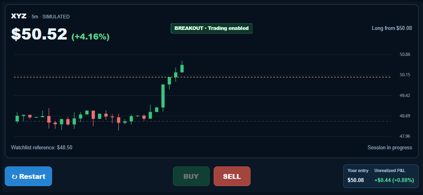
Watch a simulated stock chart unfold candle by candle. Decide when to buy, wait, or stay out across eight market scenarios.
8 interactive scenarios • No real money • Personalized feedback
The Fed, inflation and Big Tech earnings take center stage.
The week of October 26–30 brings several events that could shape the market's next move. The Federal Reserve announces its policy decision on Wednesday, October 28. Investors will be listening closely for clues about inflation, the economic outlook and the path of interest rates beyond this meeting.
Thursday brings the advance estimate of third-quarter GDP and the September personal consumption expenditures (PCE) inflation report, a closely watched measure of price pressures. Friday's Employment Cost Index adds another view of wage and compensation trends. Together, these releases could shift expectations for future Fed decisions.
Corporate earnings will be just as important. Results from Alphabet, Microsoft and Amazon will put AI spending, cloud growth and profit expectations back under the microscope. After this week's selloff, investors may pay especially close attention to what executives say about costs, cash flow and the timing of returns on their investments.
Oil prices and developments in the Middle East also remain worth following. If energy prices continue climbing, inflation worries could compete with even encouraging earnings reports. If they ease, markets may have one less obstacle to contend with.
For Dagger Trading readers, the goal is to watch how SPY, QQQ and individual stocks respond as these events unfold. A strong report can still lead to selling, and a disappointing headline can sometimes be met with buying. The reaction tells us more than the headline alone.
We’ll take a closer look at the economic calendar, major earnings reports, and what traders should watch in the Week Ahead: October 26–30.
🎮 Interactive Trading Challenge
Think You'd Make the Right Trade?
Make your choices through realistic trading scenarios involving FOMO, breakouts, stops, revenge trading and trade management... then see what you should consider before making the decision.
Dagger Trading Merch
Check out the latest Dagger Trading mugs. ☕
Trading humor, psychology, and Dagger designs... built for traders who know the battle isn't always with the chart.
Check Out the Mugs →Sources
- Associated Press — October 23 market closes and weekly performance
- T. Rowe Price — Weekly market performance, economic data and sector rotation
- Business Insider — October 23 oil and technology market developments
- Federal Reserve Bank of New York — October 26–30 economic calendar
- Kiplinger — October 26–30 Fed and economic events
- Dagger Trading — CRWV Spotlight
- Dagger Trading — NFLX Spotlight
- Dagger Trading — TSLA Spotlight
- Dagger Trading — SPCX Spotlight
Content is educational and informational only and is not financial advice.